

The logo, tagline, color, voice, tone, and especially the pricing echo your brand’s reputation and distinct identity in the marketplace. But what if the most essential part of your brand identity, which is pricing, goes against you and turns your elite brand into a cheap alternative? Ouch! It hurts, right?
- Protects & preserves brand integrity and perception
- Ensures retailers earn good profits
- Help physical retailers gain equal opportunities against online stores
- Maintains uniform brand experience across sales channels
- Keeps the prices consistent across global markets
The logo, tagline, color, voice, tone, and especially the pricing echo your brand’s reputation and distinct identity in the marketplace. But what if the most essential part of your brand identity, which is pricing, goes against you and turns your elite brand into a cheap alternative? Ouch! It hurts, right? That’s what MAP violations do.
What is a MAP Violation?
In recent years, e-commerce has snowballed, with revenue surpassing $5.3 trillion for the first time in 2026, and a year-on-year growth rate of 8.6%. Third-party marketplaces like Amazon, Pinduoduo, and TikTok are growth drivers for this. This is a clearly designed new pathway for brands in the retail marketplace and customer expansion. But it also carried some disadvantages, including counterfeit products, fake or unauthorized vendors, and MAP violations.
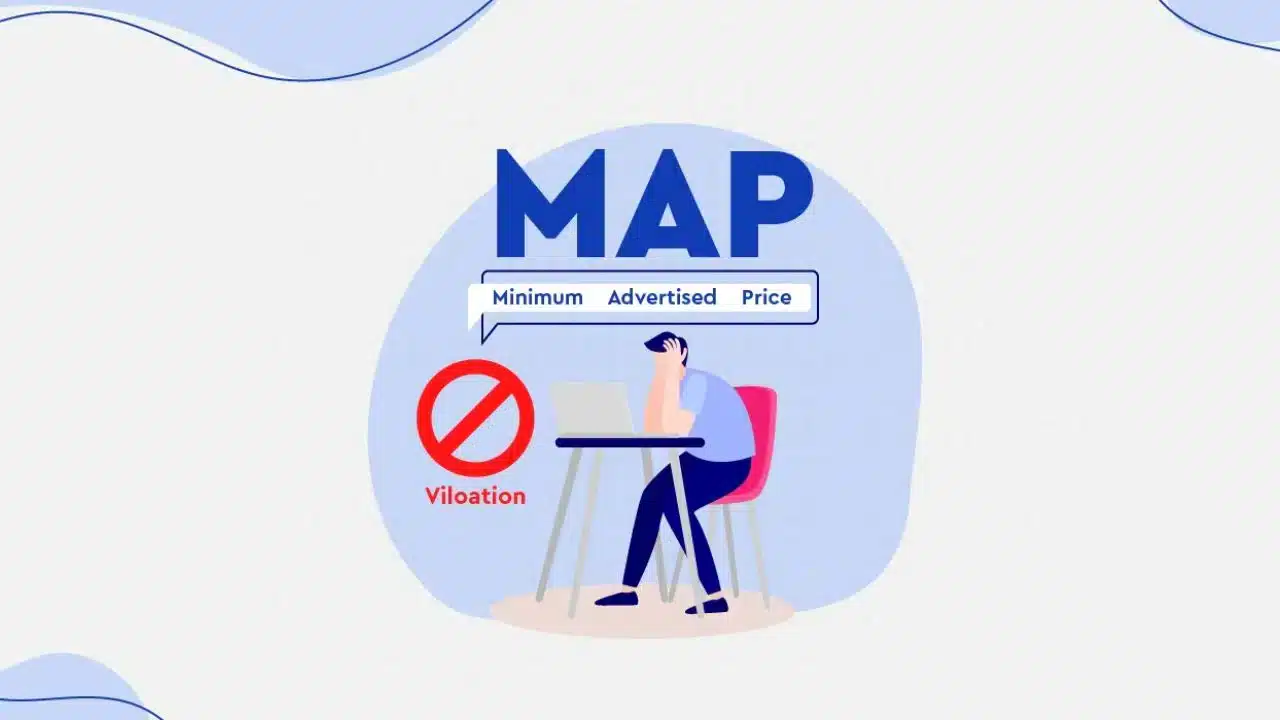
MAP refers to Minimum Advertised Price, which is a pricing limit set by manufacturers or brands. This is the final price that must be used to market or advertise a product. If a retailer advertises a product cheaper or below the MAP, it is known as a MAP violation.
It is important to understand that MAP policies only regulate advertised prices, not actual sale prices. This one rule sometimes serves as a grey area, where retailers sell at any price they want. Though they do not publicly advertise lower prices than the MAP set by the brand.
How MAP Policy Works and Its Benefits?
The policies do not dictate the final selling price of the product to customers, but they bind retailers to an accepted advertising price. It is beneficial in several ways, including:
1. Strong brand value & no price conflicts
Price wars are well capable of depleting perceived brand value. When retailers compete by lowering prices and cutting margins to surpass competitors, all of this affects the image of premium brands.
A premium product doesn’t fight for customers; it simply offers a value that customers are willing to pay for. Therefore, lowering prices frequently can harm the prestige and value in the customer’s eyes. It not only affects immediate sales but also negatively impacts long-term brand value.
2. Equal opportunities for sellers
The retail environment, specifically online shopping, is very competitive. The big retailers, with their capability to suffer losses at times and ample resources, can cut small retailers.
This reduces the options of choosing a retailer for consumers. Standard prices help retailers get a fair playing field in the market and also serve consumers with several options to choose from.
Some key benefits
- Protects & preserves brand integrity and perception
- Ensures retailers earn good profits
- Help physical retailers gain equal opportunities against online stores
- Maintains uniform brand experience across sales channels
- Keeps the prices consistent across global markets
- Protection against ‘Gray Market’ Sales
- Better retailer relationships
- Confronts challenges in e-commerce
How to Spot and Eliminate MAP Violation?

Here, we will understand the full cycle of the pricing violation, which will help in building a predictable, scalable, and enforceable process.
1. Implement MAP monitoring and detection
Detection is monitoring all your sales channels continuously, including marketplace, retailers, social media, and search ads, to find out prices mentioned below MAP. And you do not need to do all this manually in the era of artificial intelligence. Automated software crawls millions of listings daily and flags potential violations in real time.
2. Verification
After getting an alert from the automated tracking system, verify if the detected price actually breaches MAP or not. Every alert is not a true violation because there can be:
- Currency conversion mistakes
- Anomalies due to out-of-stock pricing
- Bundled product vs individual items
- Difference in domestic and international sites
- Private membership differences
Therefore, verification is essential.
3. Find out the seller’s source and document
Figure out who did this, which retailer offered lower prices than MAP, or if the stock was manipulated through distributors or not. Also, there can be an involvement of unauthorized resellers.
After finding it, documentation is important to make it undeniable evidence. Because retailers can challenge your claims, you will require legal proof. Also, it is important to maintain a record of repetitive offenders. Platforms like Amazon ebay ask for evidence to process takedowns.
4. Send notifications and warnings
It is a step where you communicate directly with the seller who has violated the policy. Inform them with clear evidence and request a correction within a set deadline. Track their response. The correction window is often short.
5. Escalate the issue
If the corrections are not made within the given time frame or if the issue persists, escalation is required. You can do it in several ways. Give them a final warning with a shorter deadline, involve the legal team if required, and notify the platform for takedown. Also, inform the distributor if the seller’s source is unauthorized.
You need full documentation, prior notification, and proof that the violation still exists. Also, keep internal notes on escalation rationale.
6. Apply fines
If the seller ignores the final warnings and does not take any steps to clear notifications and escalation, you must apply penalties consistently. It is not about punishing the vendor but protecting the brand’s values. Without significant consequences, your MAP policy is just advice.
Penalties are generally applied within 48 hours of failed escalation.
7. Resolve
It is the final step where the seller confronts and confirms the violation, and the MAP violation is finally corrected. The case is closed. Though it does not mean that the case is forgotten. The resolution includes several factors:
- The final verification confirms whether the price is now compliant
- The outcome is documented
- You must update the seller history for future references
- Have an internal debrief if the pattern persists
Types of MAP Violations
Retailers or sellers can come up with several minimum advertised pricing loopholes to attract customers and increase sales. Let us look at some of the common violations.
1. Direct price violation
It is the most obvious and upfront violation where the advertised prices are clearly mentioned below MAP. For example, a shoe worth $200 is being advertised at $180. It can be absurd on website product pages, market listings, online ads, or social media promotions.
2. Offers and discounts
It is where the price is not directly shown, but the promotional offers clearly indicate a lower price. Tactics such as Buy 1 Get 2 Free, 30% discount, or Flat 1500 off on a certain product. It’s just about the math behind the final selling price.
3. Coupons
There are public coupons that get customers discounts or benefits on the visible price of the products. These can be auto-applied coupons, discounts on the mode of payment, discount codes across sites, or Use Code MICA30 to get 30% off, shown publicly.
4. Check the cart price
One of the most common violations is where the advertised price is compliant, but the product is sold below MAP after it is added to the cart. The lower prices are visible only after adding the product to the cart.
5. Bundle sales
The vendors bundle products where the effective advertised price is dropped. For example, when someone buys a phone, there is a suggested product that has a combination of phone plus charger or phone case. Each of them has its own individual price and will be sold at the same price if bought separately. Where these three items are bundled together, the total cost becomes much less than buying them separately.
Also, sometimes accessories that have a clear standalone value are given for free with a bought product.
6. Marketplace violation
This is the most common violation that happens on third-party ecommerce websites such as Amazon, eBay, and Walmart etc. It happens due to listing mistakes, rogue sellers, and price conflicts, which are caused by automated repricing tools.
7. Global violations
These are international misconduct of MAP policies where international sellers show lower prices. The currency conversion can manipulate MAP, and region-specific listings are globally visible.
Best Ways to Avoid MAP Violations
We already discussed how to detect and resolve the violations, but prevention is always better than a cure. Therefore, let’s see what we can all do so that the violations don’t occur.
Make a clear MAP policy.
The policy must be clear and easy to understand. Clarify each point that is considered a breach or violation.
Mention the implications and consequences for not adhering to the policy. There should also be a process of handling false positives and a clearly laid out appeals process.
Make sure to define the scope of the policy as to where it can be applied. Use simple language to avoid further confusion.
Balance between MAP and MSRP
MAP is well correlated with MSRP (Manufacturer’s Suggested Retail Price). Minimum advertised pricing is typically 20%-30% lesses than the MSRP, which allows retail vendors to have a window where they can operate. Deciding on pricing is difficult in e-commerce; you must go for a price that is balanced and beneficial for both the customer and the seller.
Conduct market research, learn about competitor strategies, consider your brand position, and try using dynamic pricing.
Implement your policy effectively.
Making a policy is one thing, but communicating effectively is what matters the most. You can follow these steps to talk about your policy strongly.
- Send an email to all existing and potential retailers
- Make it visible on your website, prominently in the partner/reseller section
- Ensure it has all the onboarding materials for new resellers
- Tell your sales team to keep monitoring and discussing it with partners regularly
- Make FAQs about your MAP policies and post them on the website
Ensure standard enforcement
The enforcement of the MAP policy must be consistent across channels and partners. It should cover all small and large retailers, online and offline sellers with marketplaces, DTC sites, and ads.
Help your retailers
Educate and support your resellers about MAP policies. It mutually benefits both parties and allows better focus on business. You can save a great deal from legal issues, bitterness, and negativities.
You can offer training on the benefits of the retail ecosystem and craft easy-to-understand guidelines. Add a FAQ section that addresses the common concerns and scenarios.
Strong internal communication
Make sure that all your departments are in alignment with each other, and they coordinate well to avoid any confusion. For example, if the sales team is pushing for discounts, but legal teams want MAP enforcement.
Regular reviews and updates
The e-commerce industry is ever evolving, as we have been observing, hence you should keep a check on annual reviews. Keep modifying, editing, or omitting points and make it more current.
There should be MAP holidays for major events like Black Friday. You can also involve retailers while reviewing the policy to ask for feedback and modifications suggested.
Conclusion
MAP violations occur when the resellers advertise a product at a lower price or below the minimum advertised pricing set by manufacturers or brand owners. This is extremely harmful to the brand’s reputation, product value, and prestige in the eyes of consumers. Important things to note are that the MAP policy only regulates advertising pricing and not selling price. This gives retailers many loopholes to play with the final selling price, as we discussed. These loopholes are played in different ways as different types of MAP violation discussed. We also learned what the benefits of avoiding these breaches are and what protective measures can be taken. You also learned about the lifecycle of MAP violation. Keep evolving with the growing markets to stay ahead of the crowd.
Related: A Complete Guide to Starting a Consulting Business
Frequently Asked Questions
What is a MAP Violation?
In recent years, e-commerce has snowballed, with revenue surpassing $5.3 trillion for the first time in 2026, and a year-on-year growth rate of 8.6%. Third-party marketplaces like Amazon, Pinduoduo, and TikTok are growth drivers for this. This is a clearly designed new pathway for brands in the retail marketplace and customer expansion. But it also carried some disadvantages, including counterfeit…
How MAP Policy Works and Its Benefits?
The policies do not dictate the final selling price of the product to customers, but they bind retailers to an accepted advertising price. It is beneficial in several ways, including:
How to Spot and Eliminate MAP Violation?
Here, we will understand the full cycle of the pricing violation, which will help in building a predictable, scalable, and enforceable process.


